Hands on the trigger, eyes filled with absolute distrust toward the enemy
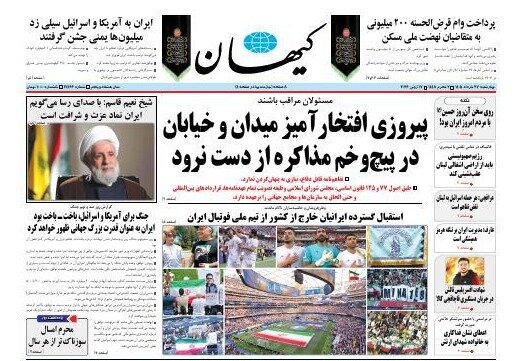
Kayhan wrote that Iran should place no trust in the recent Iran–US understanding. The paper argued: Signing a document on paper must never create the illusion that everything is over or that conditions have normalized.
The hegemonic nature of the United States has never changed. This understanding is merely a pause — a moment to regroup. Meanwhile, the dangerous variable of the Zionist regime remains fully active. Israeli officials have openly declared that they are not bound by this understanding and that they seek to sever Iran’s strategic arm, namely Hezbollah in Lebanon. To preserve national security, Iran’s ring of fire around Israel must remain intact. Ultimately, with absolute distrust and full readiness, we must recognize that this understanding is not the end of the story; the threat of aggression and assassination still exists. Therefore, hands must remain on the trigger, and we must maintain full preparedness for every scenario — including a renewed war — because true victory lies in relying on internal strength and staying ready for the enemy’s deceit.
Shargh: The understanding can become a platform for broader agreements
Shargh analyzed the Iran–US understanding as an opportunity to break multiple deadlocks. The initial understanding cannot be interpreted as the end of all disputes or the definite beginning of a new era, but it can certainly be seen as an important turning point — a shift from confrontation toward managing differences. The history of relations between the two countries shows that the distance between an initial understanding and a final agreement is a complex path filled with political, security, and legal challenges. Still, what makes this development significant is the return of diplomacy to the center of the equation after a costly period of tension and conflict. If both sides pursue gradual confidence-building and reciprocal implementation of commitments, this understanding could become a platform for broader agreements and more durable regional and international stability — though caution remains essential in assessing the future.
Etemad: This opportunity must be used
Reformist political figure Mirdamadi told Etemad that the understanding is an important and prudent step. From his perspective, Iran entered the negotiations from a position of strength after standing firm against all political and military pressures. In recent years, the United States tested every option on the table — including the military one — and the international consensus now is that Iran held the upper hand in this confrontation. This creates a golden opportunity that must not be wasted. Naturally, the path ahead will not be without challenges. Internationally, Israeli lobbies and their supporters in the US will work with full force to undermine the understanding.
Javan: Regime change will happen — but inside the United States
Javan interpreted recent strategic shifts in Trump’s cabinet and wrote: Reports indicate a gradual withdrawal of US forces from West Asia. The naval blockade has been lifted. Trump now says, “I was never seeking regime change in Iran because it was impossible”. He is lying — that was exactly what he came for, and he repeatedly claimed he would overthrow Iran’s government and destroy Iranian civilization. Now, some reports say he is seeking changes within his own cabinet — meaning regime change is happening, but inside the United States itself, just as during wartime, many US officials who opposed the war were dismissed. Now opponents of the agreement are being removed. This is a sign of Iran’s strength, which is evident in every clause of the understanding. Iran has given almost nothing and has obtained nearly everything it needed. This means the architecture of West Asia must now be viewed through an Iranian-made lens. Beyond battlefield and diplomatic victories, Iran has also achieved a major success by creating divisions within Washington’s leadership.
Arman-e-Emrooz: A new chapter of peace, stability, and cooperation in the Middle East and the world
Arman-e Emrooz focused on the global dimension of the Iran–US understanding. It wrote that resolving Iran’s nuclear issues through this understanding significantly strengthens the nuclear non-proliferation regime. Iran’s return to energy markets with substantial volume could stabilize global oil prices and prevent severe fluctuations and inflation in consumer economies. The agreement shows that even at the height of distrust, diplomacy can open a path forward. Its success, however, requires mutual goodwill, precise implementation, and avoidance of bad faith. If pursued seriously, the process could not only reduce regional tensions but also serve as a model for resolving other global crises. Iran’s economy would benefit from commercial openings, and the region would be relieved of heavy military and security burdens. Signing the understanding in Switzerland could mark the beginning of a new chapter of peace, stability, and cooperation for the Middle East and the world.